The question and the sample
Before reading an app review, a visitor often encounters two small store labels: Contains ads and In-app purchases. We examined how often these exact English labels appeared in the official Google Play pages for the 100 apps in the Appuza launch collection. The pages were retrieved on 23 October 2026 using English-language, US-region listing URLs. The sample was chosen for the publication’s coverage, not randomly selected from Google Play.
This is an observation of public listing text. It is not an installation study, a financial analysis of developers or an audit of what an application actually displays. We did not buy subscriptions, run apps on devices or measure advertising frequency. Keeping that boundary explicit makes the results more useful: they describe the information a reader could find in these particular sources.
The observed counts
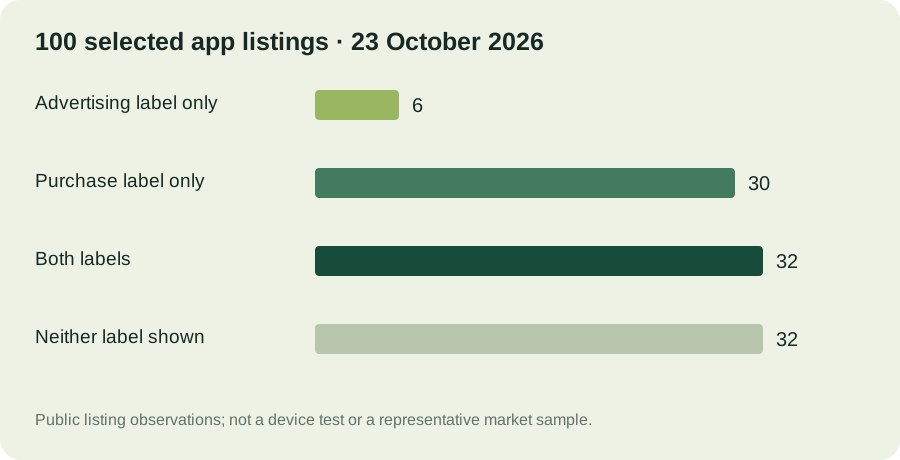
The Contains ads label appeared on 38 of the 100 retrieved pages. The In-app purchases label appeared on 62. Thirty-two pages displayed both labels, while 32 displayed neither exact label in the retrieved text. Put into mutually exclusive groups, the collection contained 6 pages with only the advertising label, 30 with only the purchase label, 32 with both and 32 with neither.
These counts refer to labels on Android app listings, not advertising on the Appuza website. They also do not say how much a user would pay or how often an advertisement would appear. A listing with both labels could support several different experiences depending on the account and product. The label is a prompt to investigate the terms, not a complete explanation of them.
How the dataset was produced
For each app, we retained its official package identifier and fetched the corresponding Google Play page with hl=en and gl=US parameters. The extraction checked normalized visible text nodes for exact matches to the two label strings. We also counted word-like tokens in the developer-description section. Every row in the downloadable CSV includes the app name, label observations, description word count, official source URL and consultation date.
The description counts ranged from 56 to 667 words, with a median of 460.5 words. That measures the length of the retrieved developer description under this token-counting method. It does not measure app quality, explanatory completeness or writing originality. A short description may explain a simple game adequately, while a longer description can still leave an important account condition unclear.
Not shown is different from does not exist
The CSV deliberately uses not shown rather than ad-free or no purchases. An exact text match cannot establish that an application has no commercial relationship, no externally managed subscription or no region-specific offer. It also cannot establish what a future version of the page will disclose. The observation belongs to the retrieved page and date, not permanently to the product.
Web pages can vary by region, language, account and presentation. A changed label, combined text node or different rendering could affect an automated extraction. The source link in each row allows a reader to inspect the current listing, but that current page may differ from the snapshot. Anyone repeating the exercise should record their own date and retrieval conditions instead of silently treating changed results as a contradiction.
How to use the result when choosing an app
Use a label to form a specific follow-up question. If an app lists in-app purchases, identify the capability that matters to you and check whether your intended account includes it. If the page lists advertising, look for the provider’s explanation of the experience you are considering. Do not infer a price, a purchase requirement or an advertisement schedule from the label alone.
The wider lesson is that a small piece of store metadata can guide research without settling the decision. Our individual app analyses add use-case questions and trade-offs, while the official listing remains the place to check current product disclosures. This study adds a reproducible view of our own collection; it does not rank developers or claim that one label combination is better for every reader.