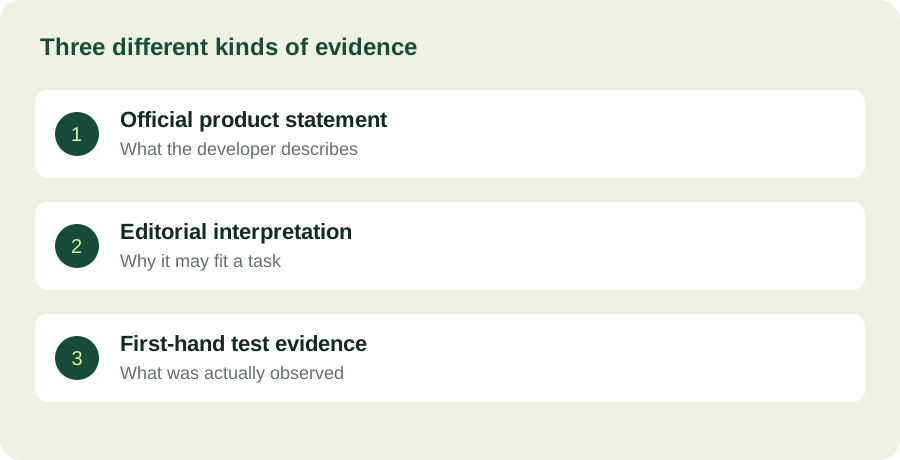
Read the claim and the evidence together
A store listing can establish that a developer advertises a particular capability. It does not independently establish how reliably that capability works on your device. A source-based analysis can explain the feature and its implications, but it should not convert the developer's claim into an invented test result.
Look for a visible description of the review method. Does the author say which device, version or workflow was tested? Are screenshots and measurements linked to that method? If the article is based on public information, it should say so directly. The absence of hands-on testing does not make every observation useless; it changes what the observation can support.
Separate facts from fit judgments
An app supporting shared notes is a product claim. The judgment that shared notes may suit a small grocery list is an interpretation about a use case. Both can be useful if the distinction is clear. Problems arise when a judgment is presented as a measured result, or when a product claim is repeated without attribution.
A useful review explains the reasoning behind a recommendation. For example, a team that needs a decision history may benefit from keeping context beside tasks. That reasoning remains understandable even if the reader decides the suggested tool is not the right one. A ranking without reasons gives the reader less to work with.
A proposed trial is not a completed experiment
Articles often suggest opening a file, checking an export or testing a notification. Those are sensible evaluation exercises when clearly written as proposals. They are not evidence that the writer performed the steps. A trustworthy account should not blur 'you could check' into 'we found.'
When a review reports a test, ask whether the described conditions resemble your intended use. A result on one device, network or account does not automatically generalize. When an article proposes a test instead, adapt it to your own needs and use expendable material rather than important files or consequential transactions.
Check dates without treating freshness as proof
A recent date is useful only if it represents actual research or a substantive update. It does not establish that every feature was rechecked. Look for the source consulted and the scope of the review. A dated article with clear limits can be more informative than a page labeled 'updated today' without explanation.
Prices, regional availability and plan limits deserve particular attention because they can vary. If a recommendation depends on a specific capability, open the current official information for your account before committing. The source link is part of the review's usefulness, not an optional decorative reference.
Use the article to make a better question
The best outcome of reading an analysis may be a more precise question to ask before installing. Do your collaborators use this messenger? Can you export the work you need? Does the plan include the feature that motivated the purchase? These questions are more actionable than a universal claim that an app is the best.
Appuza's launch articles are public-source analyses. They include AI-assisted writing and do not claim hands-on tests, numerical performance benchmarks or independent security audits. Our editorial method is intended to make that boundary visible so readers can use the analysis for what it supports and seek other evidence when a decision requires it.