 appuza
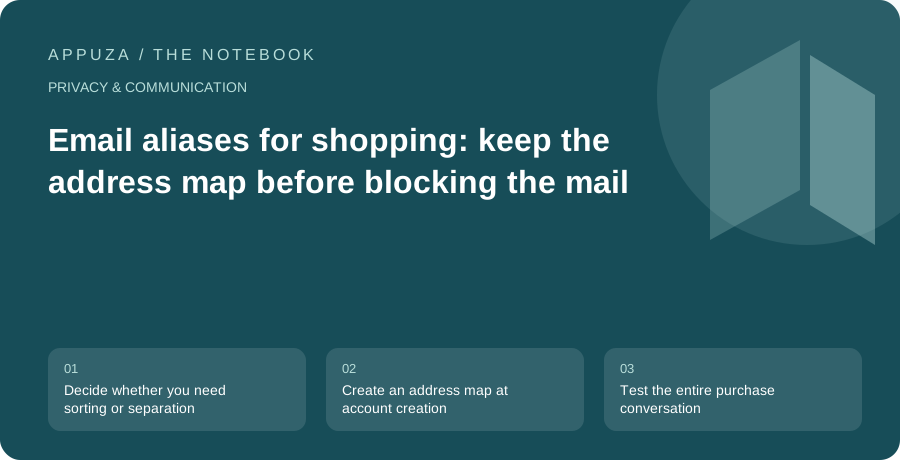
Decide whether you need sorting or separation
An email alias can solve several different problems, and the right kind depends on which one you have. If you want receipts to land under a recognizable label, a plus address may be enough where supported. If you want a merchant to receive an address that does not reveal your main mailbox, a forwarding alias serves a different purpose. If you need a public business identity that you control over the long term, a custom-domain address raises yet another set of considerations.
Proton's documentation distinguishes additional addresses, hide-my-email aliases, plus aliases, and custom-domain addresses. The practical lesson is to avoid treating all of them as interchangeable. A plus address usually makes the underlying address easy to infer; it is primarily an organizational convenience. A forwarding alias can conceal the destination from the ordinary sender, but it introduces a dependency on the forwarding service. Choose based on the relationship you need with the merchant, not on the appeal of the word private.
Create an address map at account creation
When you register for a shop, save the exact address alongside the login in your password manager or another suitable account record. Include a meaningful label identifying the merchant. Without this map, an alias can create a new problem months later: you remember buying something but cannot determine which address the shop recognizes. The alias is often part of the account's identity, not merely a route for promotional mail.
Use separate aliases where the ability to disable one relationship independently is valuable. A single shopping alias reused everywhere is simpler, but disabling it affects every merchant that knows it. A unique alias per service creates more records to maintain while giving you a clearer view of where messages arrive. There is no universal ideal number. Start with a few services whose promotional traffic you want to control, then expand only if the recordkeeping remains easy to understand.
Test the entire purchase conversation
A successful welcome email proves only that one incoming message reached you. A purchase relationship may also require order confirmations, delivery updates, return instructions, and replies to support. Before relying on an alias for an important transaction, understand how the provider handles replies and new outbound messages. Proton documents its supported alias sending and forwarding behavior; use those instructions rather than assuming that typing the alias into any From field will work.
When possible, perform a harmless exchange that lets you inspect what the recipient sees. Do not expose your main address accidentally by switching to a different reply workflow halfway through a support conversation. At the same time, avoid assuming an alias makes the entire purchase anonymous. The merchant may still receive your shipping address, payment-related information, account activity, and other details required for the transaction. The alias narrows one disclosure and gives you control over one route; it does not erase the rest of the relationship.
Treat disabling as a change to account access
The moment an alias becomes noisy, disabling it is tempting. First ask whether that address still receives password resets, receipts, warranty correspondence, or security notices. Blocking the route while leaving it attached to a live account can make later recovery difficult. If you want to keep the account, change its address through the merchant's supported settings and verify the replacement before disabling the old alias.
For a one-time purchase, keep the address working through the period in which delivery, returns, or support may matter to you. The appropriate duration depends on the product and your circumstances; a digital download and a large appliance create different follow-up needs. You do not need to keep promotional notifications enabled in the meantime. Use the merchant's subscription controls or your mailbox's filtering where appropriate, while preserving the route needed for transactional messages. This separates unwanted marketing from necessary account continuity.
Investigate unexpected mail without overclaiming its cause
A unique alias can help identify which address received an unexpected message, but that observation does not prove exactly how the sender obtained it. The address may have been shared, exposed, guessed, or used through a legitimate service relationship you overlooked. Record what you can actually observe: the alias, sender, message type, and whether it relates to the merchant. Avoid turning one unexpected email into a confident accusation without evidence.
If the traffic is unwanted, use the provider's controls and the merchant's account settings to reduce it. Be cautious with links in suspicious messages, including unsubscribe links whose sender you do not recognize. Visit the known service directly when changing account details. For a legitimate newsletter you subscribed to, its normal unsubscribe route may be the simplest fix. The alias gives you another option when ordinary controls are ineffective, but the decision should still account for the account and purchase dependencies attached to it.
Plan for changing the alias provider
A forwarding service is part of your email infrastructure. Before building hundreds of account relationships around it, understand what happens if you change plans, lose access, or decide to leave. Review the current limits and available management or export options. Do not assume that an address issued under a provider's domain can simply be transferred to another provider. A custom domain may give you different control, but it also requires maintaining registration and mail configuration.
Keep your address map current and protect the main mailbox and alias-service account with appropriate security and recovery settings. When reviewing your accounts, mark aliases whose associated services have been closed so that you can retire them deliberately. A well-run alias system should make communication easier to control without making your own account history mysterious. The durable benefit comes from three habits: know which service uses each address, test the reply path before it matters, and move recovery dependencies before cutting off a route.
Official references
These are editorial walkthroughs based on documented features, not claims of a completed device test. Product behavior can change. Send a correction.